
Lightning
Data Limitations
Historically, most lightning data have been proprietary, therefore, climatological records of the hazard are limited. However, a new NOAA satellite became operational in late 2017 and contains a significant technological advancement called the Geostationary Lightning Mapper (GLM). The GLM can detect the presence of total lightning including in-cloud, cloud-to-cloud, and cloud-to-ground. While this advancement will not provide historical lightning data, it will add to the climatological record as time goes on.
Definition and Description
A visible electrical discharge produced by a thunderstorm. The discharge may occur within or between clouds, between the cloud and air, between a cloud and the ground or between the ground and a cloud (NWS 2009).
Lightning forms from charge separation within thunderstorms, usually cumulonimbus clouds. Lightning is essentially a large spark of static electricity, similar to touching a doorknob on a dry day (although much more powerful). Most lightning forms from streamers that work their way down from the charge centers of clouds toward the ground. When it gets close to the ground, a return stroke is initiated, which we see as a flash of light. Thunder is created by a shock wave from rapid heating of the air to 18,000 degrees – hotter than the surface of the sun.
Lightning is capable of striking as far as 10 miles away from a storm. Distance can be estimated by counting the seconds between the flash and the sound of thunder. It takes 5 seconds for the shockwave to travel one mile. Lightning severity is not rated, although new detection systems allow accurate identification of lightning strikes allowing analysis of lightning frequency.
Historical Data
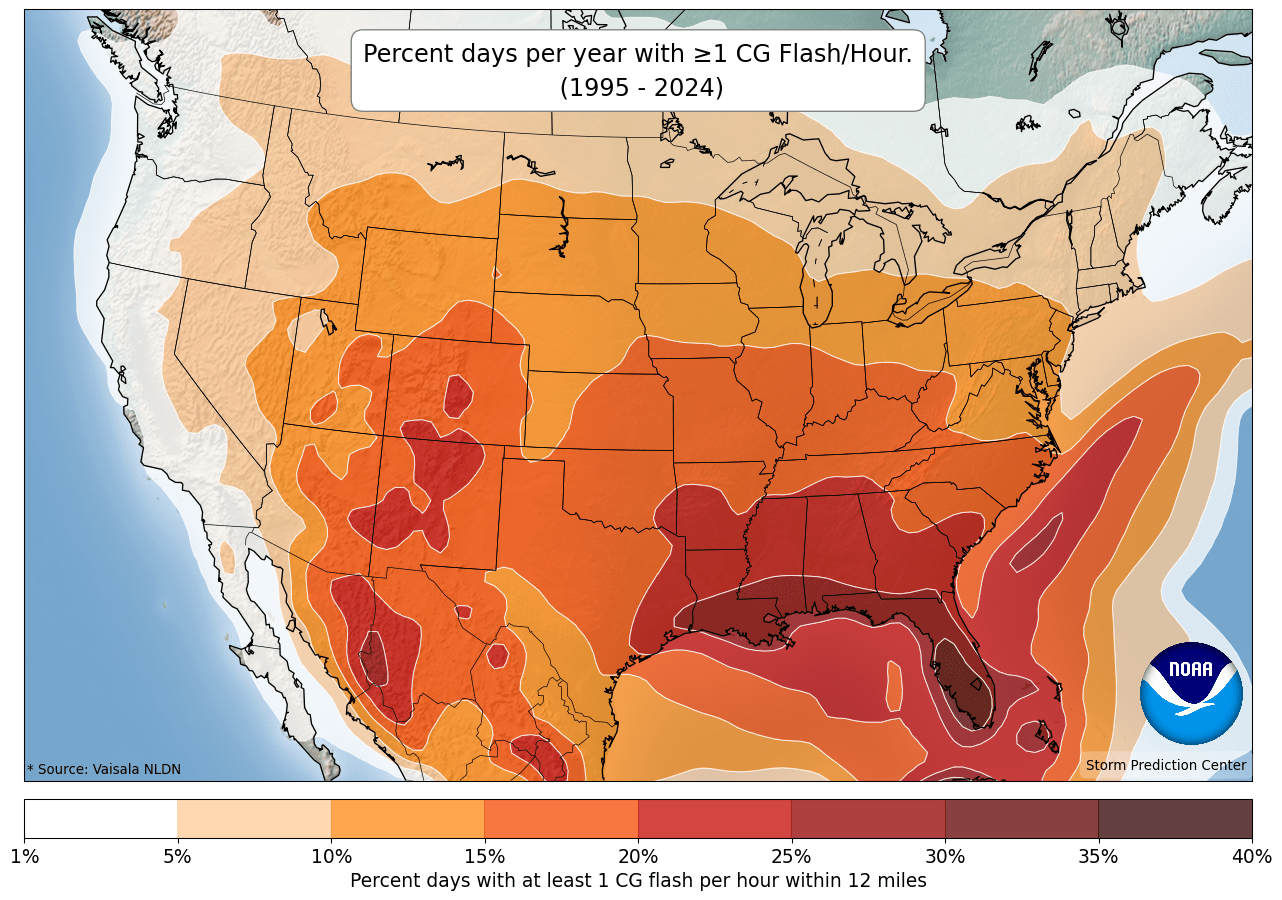
SPC Data Viewer - Lightning Climatology
(1995-2024)NOAA/NWS Storm Prediction CenterThis tool provides a lightning climatology for hourly, daily, monthly, and yearly time scales, showing the probability of cloud-to-ground (CG) lightning strikes occurring per hour during the given time frame. It can be used to assess the time of day and time of year with the highest probability of CG lightning. The tool also provides a climatology for other hazards (e.g., any severe storm, tornado, wind, hail, fire).
1. Within the Hazard drop-down menu, select Lightning. 2. Within the Climatology Interval menu, select the option you are interested in. For all options other than Yearly, there is a horizontal scroll bar under the map to change the map view to each hour, day, or month of the year. Note: Read the title and colorbar for each selection, as there are differences in what is shown. For hourly selections, note that the map title and scroll bar show hours in UTC format. 3. Within the Threshold menu, select the number of flashes of interest. 4. Under Map Overlays, check any layers of interest. 5. Click your area of interest on the map to view the probability of CG lightning for your selection. 6. Use the download feature to receive a clean output map for the full U.S. with a legend. 7. Read more about the probability calculations and map information in the About section. Note for hourly options: The pop-up box shows local time, unlike the map title.
Annual and Monthly Distributions of Cloud-to-Ground Lightning
(1995-2019)NOAA National Severe Storms Laboratory / Cooperative Institute for Mesoscale Meteorological StudiesThese static maps show the cloud to ground lightning density (strikes per km2) in Louisiana, averaged over the years 1995-2019. There are five maps on the document that display annual and seasonal (winter, spring, summer, and fall) densities. 1. Click on the link below. 2. Annual and seasonal maps are displayed with a brief description.

Vaisala Annual Lightning Report and Global Lightning Density Map
(Varies by year) VaisalaThis Annual Lightning Report has been updated annually since 2017 and includes U.S. lightning statistics and maps of average total lightning density for the most recent year and previous ~10 years in the U.S.
1. Click on the link to access Vaisala’s most recent annual lightning report. 2. Scroll down the web page to view a table of state rankings for lightning activity. 3. Below the table is a map of total lightning density in the U.S. (all lightning and cloud-to-ground lightning). The map can display the high-resolution gridded product or aggregates by county for the most recent year, the most recent ~10 years, and differences between the two.
Climate Change Trends
Studies have shown an increase in lightning associated with severe storms (Schultz et al. 2011). Climate models project an increase in the types of weather conditions that favor severe thunderstorms (Kossin et al. 2017), therefore, lightning occurrences could increase. Confidence in the projections is currently low, however, due to the isolated and sporadic nature of lightning events and limited comprehensive datasets, making it difficult to track long-term trends (Wuebbles et al. 2017a).